
Lakers Roster: Built for Now, Not Tomorrow
he Lakers roster has a single, unapologetic directive: win immediately. Rob Pelinka's offseason moves weren't about drafting a future dynasty or hoarding young assets—they were about surrounding LeBron James and Anthony Davis with proven veterans who can execute under playoff pressure. This isn't a rebuild;it's a tactical reload. The result is a roster that looks less like a long-term project and more like a collection of specialists, each with a defined role and a history of performing when it matters.
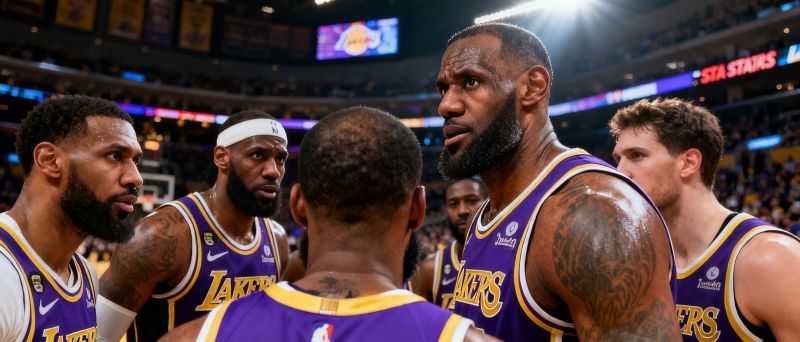
The backcourt tells the story. D'Angelo Russell's return on a team-friendly deal was a pragmatic retention, but his playoff inconsistencies remain a known risk. Enter Gabe Vincent, a Miami Heat import whose postseason resume includes an Eastern Conference Finals run and a Finals appearance. Vincent doesn't need the ball to affect winning—he defends, he hits timely threes, he doesn't flinch. His presence pushes Russell, and that internal competition is healthy. Austin Reaves, meanwhile。has quietly become the roster's most reliable connective piece;his basketball IQ and willingness to take big shots outweigh his athletic limitations. The Lakers are betting that a three-guard rotation of Russell, Vincent, and Reaves offers enough creation and defense to survive the West's elite backcourts.Up front, the decision to re-sign Rui Hachimura and Jarred Vanderbilt reflects a clear philosophy: length and versatility trump traditional positional labels. Hachimura's midrange efficiency and improved rebounding give the Lakers a legit third or fourth option, while Vanderbilt's defensive switchability is the roster's safety valve against wings like Kevin Durant and Kawhi Leonard. But here's the concern—Vanderbilt's offensive limitations make him a liability in certain matchups。and Hachimura has yet to prove he can sustain high-level play over 82 games. The Lakers are counting on LeBron's mentorship and Anthony Davis's rim protection to cover those gaps. Davis, when healthy, remains the roster's defensive anchor, but the health caveat is not a minor footnote—it's the entire thesis.Christian Wood's signing is the most intriguing gamble on the Lakers roster. A career 37% three-point shooter with legitimate shot-blocking ability, Wood theoretically fits perfectly alongside Davis in a five-out system. The word theoretically is doing heavy lifting here. Wood's defensive awareness has been criticized at every stop。and his minutes have fluctuated on winning teams. The Lakers are betting that a reduced role—spot-up threes, bench scoring, occasional small-ball five—will maximize his strengths and hide his weaknesses. If it works, the frontcourt becomes a matchup nightmare. If it doesn't, Wood joins a long list of talented bigs who couldn't adapt to LeBron's win-now timeline.Look at the depth beyond the top eight: Cam Reddish, Taurean Prince, Jaxson Hayes, and Max Christie. Prince is the underrated one—a 6'7" wing who shot 38% from deep last season and can defend both forward spots. He's the kind of player every contender needs but few rosters actually have. Reddish and Hayes are reclamation projects with athletic upside but low floors. Christie, a second-year guard, showed flashes of defensive tenacity in Summer League. The Lakers' rotation will likely shrink to nine in the playoffs。
meaning two or three of these names will disappear from the box score. That's fine—the regular season is about survival and seeding, not development. This roster is deep enough to withstand minor injuries but not deep enough to absorb a significant LeBron or Davis absence. The front office knows this. Everyone knows this. The Lakers roster is a high-stakes, low-margin bet on health, chemistry, and the stubborn belief that veteran savvy can outlast younger legs.
Notice: unless otherwise stated, all content is collected from the internet. If it infringes your rights, please contact us for removal.