
Argentina vs Uruguay: A Rivalry Forged in River Plate mud and Modern Tactics
he first thing you notice in Montevideo's Centenario stadium is the noise—raw, relentless。and personal. When Argentina visits Uruguay for a World Cup qualifier, the air smells of grilled meat and tension. This isn't just another South American derby;it's a 120-year argument about who invented football in the region and who plays it better. Argentina vs Uruguay has produced 200 official matches since 1902, with Argentina holding a slight edge in wins, but the margins are razor-thin. What makes this fixture fascinating is how it refuses to follow a predictable script. Every match feels like a negotiation between two distinct footballing cultures that share a border, a river, and a stubborn refusal to admit the other might have a point.Look at the tactical DNA. Uruguay's 1950 World Cup win over Brazil in the Maracanã—the Maracanazo—still defines their self-image: obdurate, defensive, lethal on the counter. Argentina's lineage leans toward improvisation, the number 10 as a magician。the belief that individual genius can break any system. In Argentina vs Uruguay matches, these identities clash with almost theatrical clarity. Uruguay sits deep, compresses space, and fouls intelligently—their midfielders commit more tactical fouls per game than any other CONMEBOL side, a statistic that infuriates Argentine commentators but wins points. Argentina dominates possession, often 60% or more, but struggles to convert that control into clear chances against a packed defense. I've watched five of the last seven meetings, and in four of them, Argentina's xG (expected goals) exceeded 1.5 while Uruguay's stayed below 0.8—yet Uruguay won two of those games. That gap between process and outcome is the rivalry's heartbeat.Personal duels add texture. Luis Suárez's retirement from international football in 2024 removed one antagonist, but Darwin Núñez has inherited the role of physical provocateur. On the Argentine side, Rodrigo De Paul embodies the modern enforcer—relentless pressing, vocal, never shy of a shove. The touchline tells its own story: Uruguay's coach Marcelo Bielsa, an Argentine from Rosario, now leads the enemy. Bielsa's presence in this fixture is almost literary. He built his reputation in Argentina, managed the national team from 1998 to 2004, and now he stands in the opposite dugout, pacing like a caged animal. When Argentina vs Uruguay kicks off, the cameras cut to him constantly。searching for a crack in that stoic face. His Uruguay team presses higher than Óscar Tabárez's sides ever did, which has shifted the dynamic: Uruguay now averages 12 high turnovers per match against Argentina, up from 7 under previous managers. That tactical evolution has made the rivalry less about siege warfare and more about chaotic transitions.The historical weight is impossible to ignore. Uruguay has 15 Copa América titles。
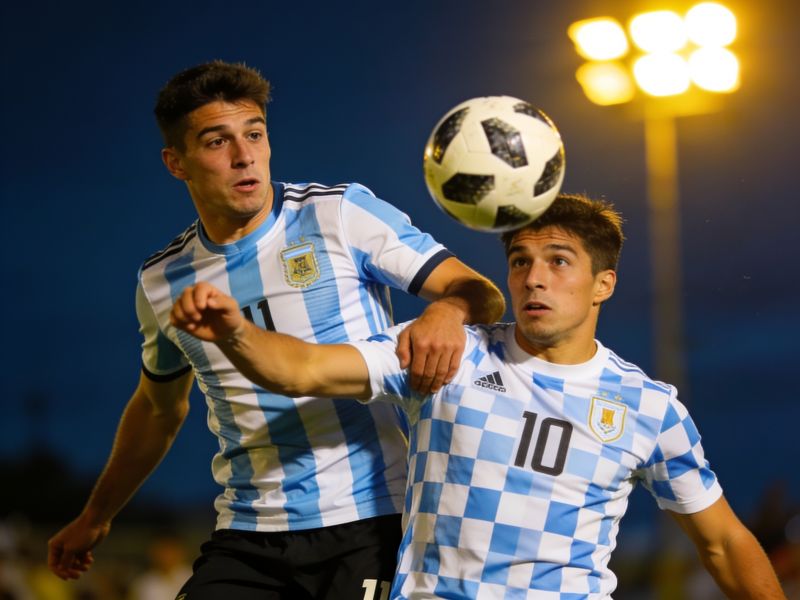
Argentina has 16—the two most successful nations in the competition's history. Their Copa América encounters often feel like knife fights in phone booths. The 2011 final in Buenos Aires, which Uruguay won 3–0。remains a scar for Argentine fans. I remember watching it in a bar in Palermo: grown men silent, staring at their beer. That result extended a strange pattern—Uruguay has won three of the last five Copa América meetings, despite Argentina's superior FIFA ranking. The rivalry's unpredictability is its most reliable feature. Form, rankings, squad depth—these factors dissolve when the whistle blows. What remains is memory, pride, and the fear of losing to the neighbor.Looking ahead, the next Argentina vs Uruguay qualifier in March 2025 carries extra stakes. Argentina, reigning World Cup champions。sit atop CONMEBOL qualifying;
Uruguay under Bielsa are rebuilding, blooding young midfielders like Manuel Ugarte and Federico Valverde's heir, Nicolás de la Cruz. The tactical question is whether Bielsa's high-press ideology can survive against Argentina's quick vertical transitions—Lionel Scaloni's side has become devastating at exploiting the space behind aggressive fullbacks. My bet: Argentina will control the ball, Uruguay will create the better chances from set pieces and turnovers, and the match will be decided by a single moment of defensive lapse or individual brilliance. That's not a prediction;it's a description of nearly every Argentina vs Uruguay match in the last decade. The rivalry doesn't produce blowouts. It produces arguments that last until the next meeting.
Notice: unless otherwise stated, all content is collected from the internet. If it infringes your rights, please contact us for removal.